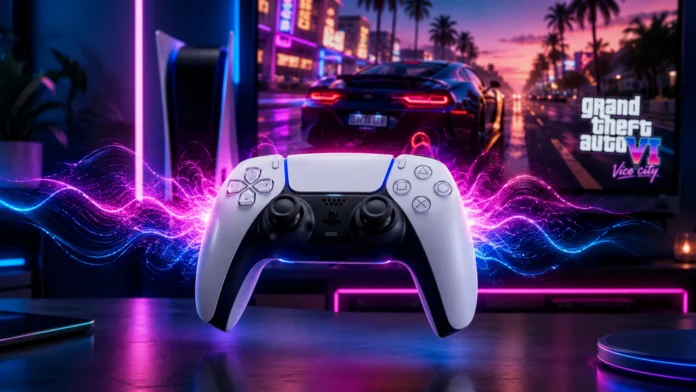
Great graphics show you an open world, but elite hardware physics let you physically feel it. When Rockstar Games launched the enhanced edition of Grand Theft Auto V, they provided a brilliant baseline for console immersion—translating gear shifts, rain patterns, and local sirens directly to your hands. With Grand Theft Auto 6, the studio is taking its custom engine integration to unprecedented microscopic levels.
By writing advanced code paths directly into the PlayStation 5’s hardware controllers, Vice City becomes a living, breathing sensory experience. Whether you are stomping on the gas pedal of a classic American muscle car or feeling the thunderous sub-bass of a subterranean nightclub, your controller is an active participant. In this guide, we break down the definitive GTA 6 DualSense features and explain how tactile mechanics enhance your gameplay immersion.
GTA 6 completely overhauls DualSense integration on the PS5. The controller’s voice-coil actuators produce directional haptic feedback that mimics specific tire surface textures, weather drops, and explosive blast radiuses. Concurrently, the adaptive triggers apply dynamic resistance levels that accurately recreate distinct firearm weight, gear changes, and engine throttle thresholds.
The Immersive Blueprint: Feature Layer Comparison
Unlike standard rumble packs that use spinning weights to violently shake your hands, the DualSense uses high-fidelity haptic motors. These act like tiny audio speakers built inside the controller grips, using precise sound frequencies to generate subtle, highly localized textures.
Here is how the game engine maps common criminal situations onto the PS5 controller architecture:
| In-Game Action Sequence | Haptic Feedback Matrix | Adaptive Trigger Profile |
|---|---|---|
| Driving Off-Road (Everglades) | Directional Mud & Grit Resistance | Loose, slipping throttle tension |
| Firing Heavy Weaponry | Heavy Kinetic Recoil Kickback | Hard click with automatic reset |
| Cruising at Midnight | Subtle, rhythmic engine purr | Stiff, variable highway cruise limit |
| Leonida Thunderstorms | Microscopic, panning raindrop taps | Static baseline environmental scale |
| Heist Security Hacks | Rotational tumblers clicking | Tactile resistance walls on lockpicks |
Haptic Feedback — Feeling the Pulse of Vice City
The standard rumble technology inside older console generations was a binary system—it was either turned fully on or completely off. The custom physics model driving GTA 6 DualSense features ties controller behavior directly to in-game telemetry scripts, calculating data like tire friction coefficients and atmospheric pressure waves.
Tactile Surface Mapping
- Tire Friction Feel wheels slip across wet asphalt patches
- Ambient Audio Club basslines reverberate through the left grip
- Explosion Radius Directional shockwaves roll across your hands
- Weather Assets Pitter-patter pacing matches storm intensities
The Atmospheric Detail Loop
When walking into a crowded venue in downtown Vice City, the internal actuators translate ambient sound frequencies into clean physical movements. If a massive explosion occurs blocks down the street to your right, you won’t experience a uniform shake. Instead, a distinct mechanical shockwave will hit your right handle first, moving smoothly across the body paneling to your left side based on your relative target positioning.
Adaptive Triggers — The Weight of a Criminal Empire
The L2 and R2 trigger mechanisms contain custom geared electric motors that allow the operating system to dynamically vary the pressure required to pull them. This technology provides an instant tactical translation tool, giving every vehicle class and firearm tier its own physical profile.
Trigger Optimization Profiles
- Supercar Throttle Stiff, high-tension acceleration curves
- Weapon Safety Wall Triggers lock slightly before firing points
- Handgun Action Lightweight pull with crisp break clicks
- Braking Systems Heavy resistance mimics anti-lock ABS brakes
Why Gunplay and Driving Feel Unmatched
When tracking an enemy with a high-caliber assault rifle, the R2 button doesn’t slide smoothly backward. It hits a solid mechanical wall that acts like a real firearm sear trigger. You must apply a deliberate, heavy squeeze to breach that resistance ceiling. Once the gun fires, the trigger forcefully kicks back against your index finger, requiring you to actively counter the mechanical recoil to land subsequent follow-up shots.
Never turn off your built-in controller speaker when diving into GTA 6. Rockstar uses this specialized channel to separate vital atmospheric radio chatter, incoming police dispatcher alerts, and personal phone calls cleanly away from your main home sound system. Additionally, the integrated touch-pad lightbar flashes deep red and blue during high-speed police chases, transforming your dark room into an immersive chase scene.
Standard Controller vs DualSense Edge: Which Rules?
✅ Stick with Standard DualSense If:
- You prefer traditional, comfortable weight profiles over long hours
- You want maximum battery lifecycle runtimes during standard campaigns
- You are a casual player who does not engage heavily in competitive PvP arenas
✅ Upgrade to DualSense Edge If:
- You demand physical rear paddles for fast jumps and reloads while aiming
- You want to tweak internal joystick actuation dead zones for precise target locks
- You want to physically lock trigger distances to bypass resistance walls entirely
Final Thoughts
True next-generation presentation isn’t built exclusively out of high pixel counts or asset load speeds; it requires an active, physical loop between player movement and hardware feedback. Ensuring your console controller settings are optimized for high haptic outputs guarantees your entrance into Vice City’s intense criminal networks feels exactly as the developers intended.
Frequently Asked Questions
Do intense haptic features drain the controller battery faster?
Can I turn down the trigger resistance if it hurts my fingers?
Will these advanced DualSense features work if I use the controller on a PC?